Why banking modernization is not just a technology story
- Zandra Franco

- May 31
- 4 min read
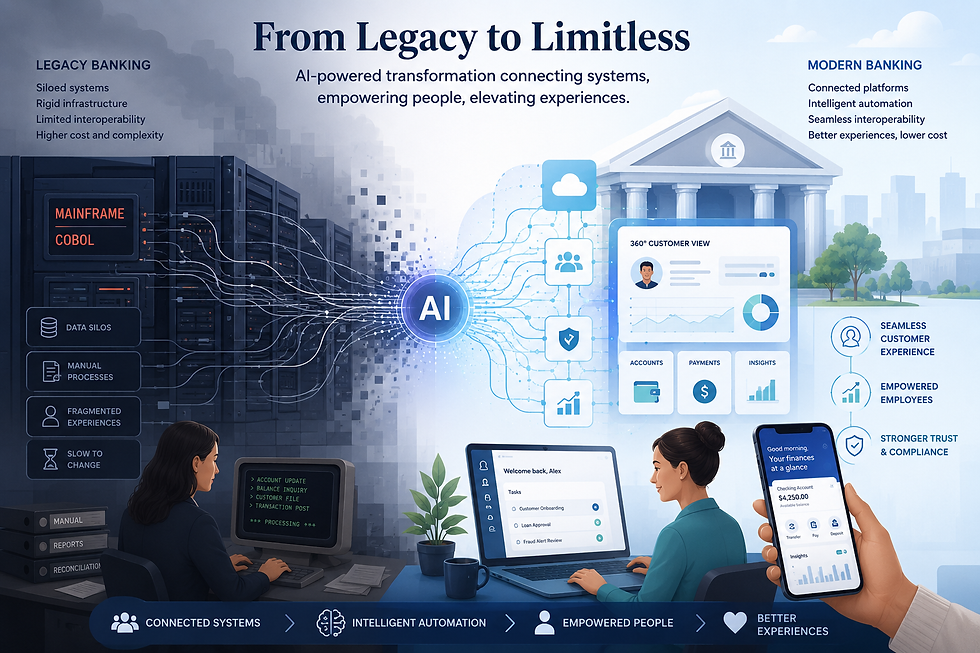
In banking, modernization does not always begin in the back end. It often starts with front-end fixes, remediation efforts, or incremental improvements designed to ease friction in the near term. But over time, the deeper constraints of legacy architecture become harder to ignore, and that is when modernization stops being only a technology discussion and becomes an experience one as well.
They start with legacy systems, core platforms, technical debt, mainframe dependencies, and long-standing infrastructure that has become harder to maintain, integrate, or evolve. Those are real and necessary concerns. But what is easy to forget is that these decisions rarely stay in the back end. They surface in the experience.
They show up when a customer cannot move seamlessly across channels. They show up when an employee has to navigate multiple systems to answer a simple question. They show up when the organization’s architecture makes the experience feel more fragmented than it should.
That is why I think banking modernization is not just a technology story. It is also an experience story.
This feels especially relevant now as AI becomes more present in modernization conversations. There is growing interest in how AI can help banks accelerate transformation, whether through code generation, workflow redesign, documentation support, operational insights, or helping teams bridge from older environments into more modern architectures. The opportunity is real. Deloitte has noted that successful mainframe modernization can improve innovation, customer experience, cost optimization, security, compliance, and even talent attraction. Deloitte also argues that an AI-powered bank should be able to improve both customer experience and employee productivity, even as existing tech debt and complex stacks continue to slow progress.
What stands out to me, though, is that the value of modernization is not only in replacing old systems. It is in reducing the friction those systems create around them.
That includes the friction customers feel when their journey breaks because systems do not communicate well behind the scenes. It also includes the friction employees feel when they must work across disconnected tools, manual workarounds, and limited interoperability just to deliver what should feel like a coherent service.
This is where AI can be helpful, but also where its role needs to be understood clearly.
McKinsey’s research on AI in banking suggests that real value comes when banks move beyond experimentation and begin rewiring the enterprise around critical workflows. That is an important distinction. AI can support transformation, but it does not replace the need for structural change. In one example McKinsey shared, a regional bank used gen AI to improve software development productivity, helping teams work more efficiently and improving the coding experience for developers. That matters, especially in institutions still carrying significant legacy complexity. But productivity gains in isolation are not the same as modernization done well.
The same point is echoed in DORA’s 2025 report on AI-assisted software development, which argues that AI tends to amplify the strengths and weaknesses already present in an organization. That insight feels especially relevant in banking. If the underlying architecture, governance, operating model, and collaboration patterns are fragmented, AI may accelerate output without necessarily improving the broader system around it.
That is why the human dimension of modernization matters so much.
From a customer perspective, modernization should mean more than digital polish. It should mean fewer breakdowns, less repeated effort, more continuity, and greater confidence that the institution is working as one connected system. J.D. Power’s 2025 banking research points to the gains that come from stronger digital experiences, but it also highlights that some customers still report weaker experiences when they need more personalized support, advice, or problem resolution. That is an important reminder that seamless front-end experiences depend on more than surface-level design. They depend on what the organization can actually support behind the scenes.
From an employee perspective, modernization should also reduce the burden of navigating complexity. In many institutions, employees are still the ones absorbing the gaps between legacy systems, translating across fragmented processes, and compensating for interoperability that customers cannot see directly. When modernization is done well, it does not just create new technical capability. It creates better working conditions for the people responsible for delivering the experience every day.
That is why I think the most useful framing is not that AI will modernize banking on its own. It is that AI may help banks move faster, but the real measure of modernization is whether the experience becomes more connected, more usable, and more resilient for both customers and employees.
In that sense, modernization is not only about changing infrastructure. It is about changing what people feel on the receiving end of that infrastructure.
For leaders, this raises an important question. Not just how to modernize, but how to ensure that modernization improves interoperability, reduces hidden friction, and strengthens the experience across the system rather than only within the technology stack.
Because in banking, legacy complexity does not stay hidden for long. It eventually reaches the surface.
And when it does, customers feel it. Employees carry it. And experience is where its cost becomes most visible.
This reflection emerged from patterns I have been noticing in digital experiences and was further informed by current research on AI-assisted design, product delivery, and usability. Selected references include:
Deloitte, Navigating the complexities of mainframe modernization in bankingDeloitte, Future of software engineering in banksMcKinsey, Extracting value from AI in banking: Rewiring the enterpriseJ.D. Power, 2025 U.S. National Banking Satisfaction StudyJ.D. Power, 2025 U.S. Retail Banking Satisfaction StudyDORA, State of AI-assisted software development 2025


Comments